
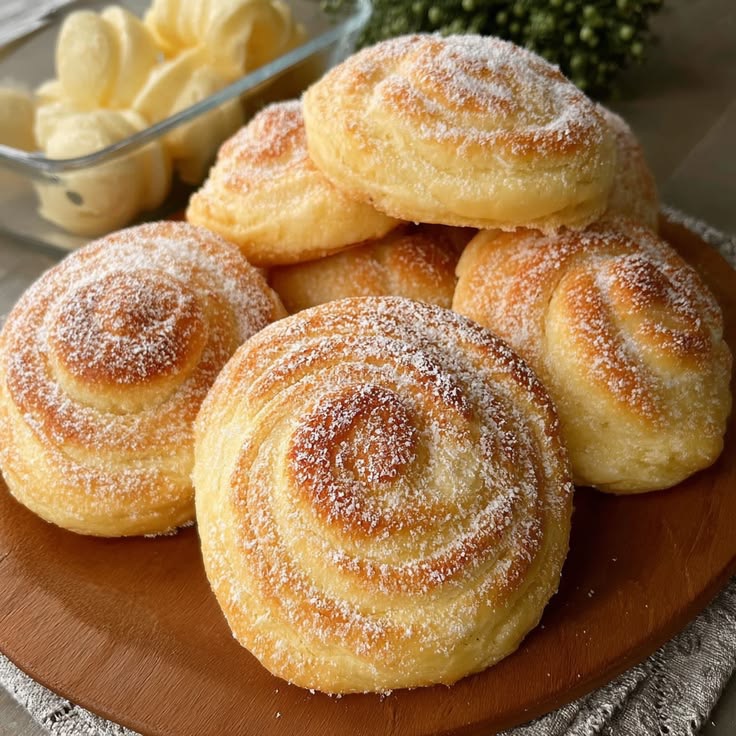
Ensaymada Rolls
Also called Filipino Sweet Bread Rolls or Philippine Brioche, ensaymada is a beloved bakery classic across the Philippines. The name comes from the Spanish ensaimada, but the Filipino version evolved into something softer, richer, and more bread-like than its European cousin. These are pillowy spirals of enriched yeast dough, baked until golden and tender. Traditionally they are topped with butter, sugar, and grated cheese, but the plain roll itself is so soft and buttery that it is delicious on its own.
This recipe focuses on the base dough so you can finish it however you like. The crumb is light and shreddy, with a rich flavor from eggs, milk, and butter. It is the kind of bread that tears apart in soft layers and stays moist for days. Serve it for breakfast with coffee, as a merienda snack, or alongside hot chocolate. One batch makes 12 rolls, and they freeze beautifully.
What Makes a Great Ensaymada
The texture is the point. A proper ensaymada should be soft enough to press with a finger and watch it bounce back, but it should also have structure. That comes from a dough enriched with eggs and butter, and from good gluten development. Unlike a standard dinner roll, ensaymada uses more sugar and fat, which makes the crumb tender and gives it a longer shelf life. The spiral shape is not just for looks. Rolling the dough creates thin layers that separate slightly as they bake, giving you that signature feathery texture.
The key is patience. Enriched doughs rise slower because fat coats the flour and limits gluten formation. Do not rush the proofing. A slow, cool rise develops flavor and keeps the rolls from tasting yeasty. Kneading until the dough passes the windowpane test gives you the strength to hold all that butter without collapsing.
Ingredients
Makes 12 rolls
For the Dough
All Purpose Flour: 3½ cups, about 440 grams. You can use bread flour for a chewier roll, but all purpose gives you the classic softness. Spoon and level your flour so you do not pack it in. Too much flour makes a dry roll.
Granulated Sugar: ¼ cup. This feeds the yeast and lightly sweetens the dough. Traditional ensaymada is not very sweet because the toppings add sugar later.
Active Dry Yeast: 2¼ teaspoons, one standard packet. You can use instant yeast instead. If you do, skip the proofing step and add it directly to the flour.
Salt: 1 teaspoon. Salt controls yeast activity and strengthens gluten. Do not skip it or the rolls will taste flat.
Warm Milk: ¾ cup, about 110°F. Whole milk gives the best flavor and tenderness. The temperature matters. Too hot kills the yeast. Too cold and it will not activate. It should feel like warm bath water.
Large Eggs: 2, at room temperature. Cold eggs will cool down the dough and slow the rise. Set them in warm water for 5 minutes if you forgot to take them out.
Unsalted Butter: ⅓ cup, 5 tablespoons, very soft but not melted. The butter needs to be pliable so it incorporates smoothly. If it is melted, the dough will be greasy. If it is cold, it will not mix in.
For Brushing Before Baking
Egg Wash: 1 egg beaten with 1 tablespoon milk. This gives the rolls a golden shine.
Melted Butter: 2 tablespoons, for brushing after baking. This keeps the crust soft and adds flavor.
This base recipe makes the plain roll shown in the image, dusted lightly with powdered sugar. You can leave them plain or add traditional toppings after baking. See the variations section for the classic butter sugar cheese finish.
Equipment You Need
Stand mixer with dough hook, or a large bowl and your hands
Kitchen scale, optional but helpful
Measuring cups and spoons
Bench scraper
9×13 inch baking pan or two 9 inch round pans
Pastry brush
Plastic wrap or clean kitchen towel
Instant read thermometer, helpful for checking milk and doneness
Step by Step Instructions
Activate the Yeast
If using active dry yeast, pour the ¾ cup warm milk into a bowl. The temperature should be between 105°F and 115°F. Add the 2¼ teaspoons yeast and a pinch of the ¼ cup sugar. Stir once and let it sit for 5 to 10 minutes. It should get foamy and smell yeasty. If it does not foam, your yeast is dead or the milk was too hot. Start over with new yeast.
If using instant yeast, skip this step. You will add it directly to the flour.
Mix the Dough
In the bowl of a stand mixer, combine 3½ cups flour, the remaining sugar, and 1 teaspoon salt. Whisk to distribute. Add the 2 eggs and the milk yeast mixture. If using instant yeast, add it now and pour in the warm milk.
Mix on low speed with the dough hook until a shaggy dough forms, about 1 minute. Scrape the bowl. Increase to medium low and knead for 5 minutes. The dough will be sticky and rough.
Add the Butter
With the mixer running on medium low, add the ⅓ cup soft butter one tablespoon at a time. Wait until each piece is mostly incorporated before adding the next. This takes about 3 minutes. The dough will look like it is falling apart at first. Keep going.
Once all the butter is in, increase to medium speed and knead for 8 to 10 more minutes. The dough should clean the sides of the bowl, look smooth and shiny, and feel soft and tacky but not sticky. Do the windowpane test. Take a small piece and gently stretch it. If you can stretch it thin enough to see light through without it tearing, the gluten is developed. If it tears, knead 2 more minutes and test again.
First Rise
Transfer the dough to a lightly greased bowl. Turn it to coat. Cover with plastic wrap or a damp towel. Let it rise in a warm spot for 1½ to 2 hours, until doubled in size. Enriched dough takes longer than lean dough. If your kitchen is cold, let it rise in the oven with just the light on. Do not rush it.
For better flavor, you can do a cold rise. Cover the bowl and refrigerate overnight, 8 to 12 hours. The dough will rise slowly and develop more complexity. Let it sit at room temperature for 30 minutes before shaping.
Shape the Rolls
Punch down the dough to deflate it. Turn it out onto a lightly floured surface. Divide into 12 equal pieces, about 70 grams each if you are using a scale. This keeps the rolls uniform so they bake evenly.
Take one piece and roll it into a rope about 12 inches long. Try to keep the thickness even. Starting at one end, coil the rope into a spiral, tucking the end underneath so it does not unravel. Place it in a greased 9×13 inch pan or in two 9 inch round pans, leaving about ½ inch between rolls for room to expand. Repeat with the remaining pieces.
Second Rise
Cover the pan loosely with plastic wrap or a towel. Let the rolls rise again until puffy and nearly doubled, 45 minutes to 1 hour. When you press one gently with a finger, the dough should slowly spring back and leave a small indent. If it springs back fast, it needs more time. If the indent stays, it is overproofed.
Preheat the oven to 350°F during the last 20 minutes of rising. Position a rack in the center.
Bake
Brush the tops of the rolls gently with egg wash. This gives them that golden color. Do not let the wash drip down the sides or it can glue the rolls to the pan.
Bake for 18 to 22 minutes. The tops should be deep golden brown and the internal temperature should read 190°F on an instant read thermometer. If the tops are browning too fast, tent the pan loosely with foil for the last 5 minutes.
Finish and Cool
As soon as the rolls come out, brush them with 2 tablespoons melted butter. This keeps the crust soft and adds flavor. Let them cool in the pan for 10 minutes, then transfer to a wire rack.
If you want to serve them as shown in the photo, let them cool completely and dust lightly with powdered sugar. For traditional ensaymada, move to the variations section.
Expert Tips for Soft, Fluffy Rolls
Weigh Your Flour: A cup of flour can weigh anywhere from 120 to 150 grams depending on how you scoop. For consistency, weigh it. 3½ cups equals about 440 grams.
Control Dough Temperature: The ideal dough temperature after mixing is 75°F to 78°F. If your kitchen is hot, use cool milk. If it is cold, use slightly warmer milk. Dough that is too warm will ferment too fast and taste sour.
Do Not Add Too Much Flour: The dough should be tacky. If you keep adding flour because it sticks to your hands, you will get dry rolls. Use a bench scraper and light dusting instead.
Knead Enough: Enriched doughs take longer to develop gluten because the fat slows it down. If you underknead, the rolls will be crumbly and will not rise tall. Use the windowpane test.
Proof Fully: Underproofed rolls are dense and can blow out the sides in the oven. Overproofed rolls will collapse. Look for a 50 to 75 percent increase in size, not necessarily a full double on the second rise.
Bake to Temperature: Color is not always reliable. Enriched doughs brown fast due to sugar and milk. Check that the center reaches 190°F to ensure they are baked through but still moist.
Troubleshooting
Dough Did Not Rise: Your yeast was dead, the milk was too hot, or the room was too cold. Test yeast before starting. Create a warm spot for rising like an oven with the light on.
Rolls Are Dense: Too much flour, underkneading, or underproofing. Measure carefully, knead to windowpane, and give the dough time to rise.
Rolls Spread Instead of Up: The dough was too soft or overproofed. Chill the shaped rolls for 15 minutes before the final rise if your kitchen is hot. Make sure they are close together in the pan so they support each other as they rise.
Crust Is Hard: You skipped the butter brush after baking, or you baked too long. Brush with melted butter right out of the oven and cover the rolls with a clean towel as they cool to trap steam.
Yeasty Flavor: The dough fermented too fast or too long. Keep the first rise under 2 hours at room temperature, or use the fridge for an overnight rise.
Classic Toppings and Variations
Traditional Ensaymada
While still warm, brush each roll generously with softened butter, about 1 tablespoon per roll. Sprinkle heavily with granulated sugar, then top with finely grated queso de bola or sharp cheddar. The heat melts the butter, the sugar sticks, and the cheese softens slightly. This is the bakery style most Filipinos grew up with.
Ube Ensaymada
Add ¼ cup ube halaya to the dough with the eggs. Replace 2 tablespoons of milk with ube extract for color and flavor. Fill with ube jam before rolling, or top the baked rolls with ube buttercream and grated cheese.
Cheese Filled
After rolling the rope, flatten it slightly with your fingers. Place a stick of cheddar or cream cheese in the center and pinch the dough to seal. Coil and bake as directed. The cheese melts inside and gives you a savory bite.
Cinnamon Sugar
Before coiling each rope, brush with melted butter and sprinkle with a mix of ¼ cup sugar and 1 tablespoon cinnamon. Roll up and bake. After baking, drizzle with a simple glaze of powdered sugar and milk.
Mini Ensaymada
Divide the dough into 24 pieces instead of 12. Roll each into an 8 inch rope and coil. Bake in mini muffin tins for 12 to 14 minutes. These are perfect for parties.
Vegan Version
Replace milk with full fat oat milk or soy milk. Use 2 flax eggs, 2 tablespoons ground flaxseed mixed with 5 tablespoons water, instead of eggs. Replace butter with vegan butter sticks, not tub spread. The texture will be slightly less rich but still soft.
Make Ahead and Storage
Overnight Dough: After kneading, cover and refrigerate the dough for the first rise up to 24 hours. The slow cold ferment improves flavor. Let it sit at room temperature for 30 minutes before shaping.
Freeze Before Baking: Shape the rolls and place them in the pan. Cover tightly with plastic wrap and freeze. When ready to bake, thaw overnight in the fridge, then let rise at room temperature for 1 to 2 hours until puffy. Bake as directed.
Freeze After Baking: Cool the baked rolls completely. Wrap individually in plastic wrap and place in a freezer bag. Freeze up to 3 months. Thaw at room temperature or microwave for 20 seconds. Reheat in a 300°F oven for 5 minutes to refresh.
Room Temperature: Store baked rolls in an airtight container for up to 3 days. The butter and sugar in the dough keep them soft longer than lean bread. If they start to dry out, microwave for 10 seconds or toast lightly and spread with more butter.
Frequently Asked Questions
Can I use bread flour instead of all purpose?
Yes. Bread flour will give you a chewier roll with more structure. The rolls will rise a bit taller. If you want the classic soft, tender ensaymada, stick with all purpose. For a mix, use half bread flour and half all purpose.
Why is my dough so sticky?
Enriched doughs are sticky by nature due to the eggs and butter. Resist adding more flour. As the gluten develops, it will become less sticky. Use a bench scraper and lightly oiled hands to handle it.
Can I make this without a stand mixer?
Yes. Mix the dough in a bowl with a wooden spoon, then knead by hand on a lightly floured surface for 12 to 15 minutes. It is a workout, but it works. The dough is ready when it is smooth and passes the windowpane test.
My rolls did not coil neatly. Help.
The rope might be too short or uneven. Aim for 12 inches and keep the thickness consistent. If the end pops up, tuck it under the roll and pinch it to the bottom. After the second rise, the rolls will puff and hide small flaws.
Can I halve the recipe?
Yes. Use 1 egg plus 1 yolk, or beat 2 eggs and measure out half by weight. The rest of the ingredients halve easily. Bake in an 8 inch round pan for 6 rolls.
What is the difference between ensaymada and brioche?
They are similar enriched breads, but ensaymada uses less butter and sugar than classic brioche and is shaped into a spiral. Brioche is usually baked in a loaf or in fluted molds. Ensaymada is also traditionally topped with sugar and cheese, while brioche is often plain.
Serving Suggestions
Ensaymada is usually eaten for breakfast or merienda with coffee or hot chocolate. The plain roll is perfect for dipping. If you add the butter sugar cheese topping, it becomes dessert. In the Philippines, it is common to give boxes of ensaymada as gifts during the holidays.
For a modern brunch board, serve warm rolls with a selection of spreads. Butter, fruit jam, ube halaya, and coconut jam all work. Add fresh fruit on the side to balance the richness.
Because the dough is not very sweet, it also pairs with savory foods. Try a roll alongside chicken sopas or arroz caldo. The soft bread is ideal for soaking up broth.
Final Thoughts
Ensaymada is more than a recipe. It is a comfort food that shows up at every Filipino celebration. Learning to make the base dough opens up dozens of variations, from the classic cheese topped version to modern flavors like ube and matcha. The techniques here, proper kneading, slow rising, and gentle shaping, apply to all enriched breads.
Do not be discouraged if your first batch is not perfect. Bread baking is about feel, and each time you make it you will understand the dough better. The smell of these rolls baking will bring people to the kitchen. The first warm, buttery bite will show you why this bread has lasted generations.