
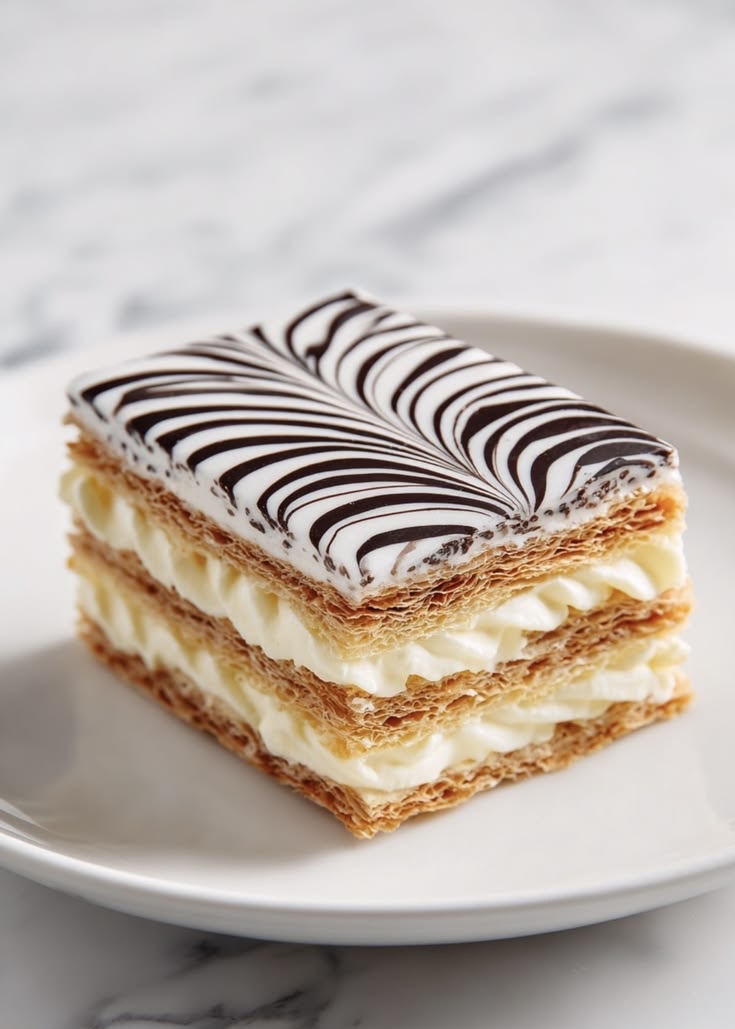
Mille-Feuille
Also called Napoleon or French Vanilla Slice, the mille-feuille is one of the most iconic pastries in French pâtisserie. The name translates to “thousand leaves” and refers to the hundreds of delicate, buttery layers you get when you bake puff pastry correctly. A proper mille-feuille has three layers of shatteringly crisp puff pastry and two generous layers of silky vanilla pastry cream. The top is sealed with a smooth white fondant glaze and decorated with the classic feathered pattern using melted chocolate. It is elegant, technical, and worth every step.
This version is written for home bakers. You can use store bought all-butter puff pastry to save time, or make your own if you want the full experience. The pastry cream is rich but not too sweet, so it balances the crisp layers and the sugary glaze. Plan for about 45 minutes of active work and 2 hours of chilling. The pastry is best assembled the day you serve it so the layers stay crisp.
Why This Recipe Works
The contrast is everything. You get the crunch of caramelized puff pastry, the cool creaminess of vanilla pastry cream, and the sweet snap of set fondant on top. The key to real bakery texture is baking the puff pastry between two sheet pans. This keeps it flat and dense instead of puffing up into a croissant. It also encourages even caramelization, which gives you flavor and structure.
Pastry cream needs to be thick enough to slice cleanly but still smooth on the tongue. Cornstarch gives it stability so it will not ooze out when you cut the dessert. Butter adds richness and helps it set. The fondant glaze sets firm so you can create the feathered design without it bleeding.
Ingredients
Makes one 9×12 inch slab, about 8 to 10 servings
For the Puff Pastry Layers
Puff Pastry: 1 pound, 2 sheets, all-butter preferred. Pepperidge Farm works, but all-butter brands like Dufour or Trader Joe’s give better flavor. Thaw in the refrigerator overnight. Do not thaw on the counter or the butter will melt.
Powdered Sugar: ¼ cup, for dusting. This caramelizes in the oven and gives the pastry color and sweetness.
For the Vanilla Pastry Cream
Whole Milk: 2 cups. Whole milk gives the best flavor and body. Low fat milk makes a thin cream.
Granulated Sugar: ½ cup, divided. Half goes in the milk, half gets whisked with the yolks.
Cornstarch: ¼ cup. This is the main thickener. It is more stable than flour and gives a cleaner flavor.
Egg Yolks: 4 large. Save the whites for meringue or an omelet. Yolks add richness and color.
Salt: ¼ teaspoon. Salt sharpens the vanilla and balances sweetness.
Pure Vanilla Extract: 2 teaspoons, or 1 vanilla bean. If using a bean, split and scrape the seeds into the milk. The seeds give a classic speckled look.
Unsalted Butter: 2 tablespoons, cut into pieces. Stirred in at the end for gloss and flavor.
For the Fondant Icing
Powdered Sugar: 1½ cups, sifted. Sifting prevents lumps in the glaze.
Milk or Water: 2 to 3 tablespoons. Add slowly to get a thick but spreadable consistency.
Light Corn Syrup: 1 teaspoon, optional. This keeps the fondant shiny and prevents cracking.
Dark Chocolate: 1 ounce, melted. Use good quality chocolate, 60 to 70 percent cacao. You can also use 2 tablespoons of chocolate chips.
Equipment You Need
2 half sheet pans, same size
Parchment paper
Rolling pin
Sharp chef’s knife or pizza cutter
Medium saucepan
Whisk
Fine mesh strainer
Mixing bowls
Rubber spatula
Offset spatula
Piping bag or small zip top bag
Toothpick or skewer for feathering
Step by Step Instructions
Bake the Puff Pastry Layers
Preheat your oven to 400°F. Line a half sheet pan with parchment paper.
Unfold one sheet of thawed puff pastry onto a lightly floured surface. Roll it gently to smooth the seams and extend it slightly to a 10×14 inch rectangle. It should be about 1/8 inch thick. Transfer to the prepared pan. Prick the entire surface with a fork every ½ inch. This is called docking and it helps prevent large bubbles.
Dust the surface evenly with 2 tablespoons of powdered sugar using a fine mesh strainer. Place a second piece of parchment on top of the pastry, then set a second sheet pan directly on top. This weight keeps the pastry from rising too much and creates the dense, shattery layers you want.
Bake for 15 minutes. Remove the top sheet pan and parchment. The pastry should be pale and set. Dust with another light layer of powdered sugar. Return to the oven, uncovered, for 8 to 12 more minutes. Watch closely at the end. The sugar will caramelize and the pastry will turn deep golden brown. It should look glossy and feel firm. If it is still pale, it will be soggy later.
Remove and cool completely on a wire rack. Repeat with the second sheet of puff pastry. You need three baked layers total, so trim each baked sheet into thirds. Use a sharp serrated knife and a gentle sawing motion. You should end up with three 4×9 inch rectangles. Save the scraps for snacking or crush them for garnish. If your pastry baked unevenly, choose the two flattest pieces for the bottom and middle, and the nicest looking one for the top.
Make the Vanilla Pastry Cream
In a medium saucepan, combine 2 cups milk and ¼ cup of the sugar. If using a vanilla bean, add the seeds and pod now. Heat over medium until it just starts to steam and you see small bubbles at the edge. Do not let it boil.
In a bowl, whisk 4 egg yolks, the remaining ¼ cup sugar, cornstarch, and salt until smooth and pale. This takes about 1 minute. The mixture will be thick.
Temper the yolks. Slowly pour about ½ cup of the hot milk into the yolk mixture while whisking constantly. This warms the yolks so they do not scramble. Pour the warmed yolk mixture back into the saucepan with the remaining milk, whisking constantly.
Return the pan to medium heat. Whisk constantly as the mixture thickens. It will look lumpy at first, then suddenly smooth out and bubble. Once it bubbles, cook for 1 full minute to activate the cornstarch and cook out any starchy taste. The cream should be very thick, like pudding.
Remove from heat. Strain through a fine mesh strainer into a clean bowl to remove any cooked egg bits and the vanilla pod. Stir in 2 teaspoons vanilla extract and the 2 tablespoons butter until melted and smooth.
Press plastic wrap directly onto the surface of the cream so a skin does not form. Refrigerate at least 2 hours, or until completely cold. Pastry cream must be cold to pipe and hold its shape. You can make it up to 3 days ahead.
Assemble the Layers
Whisk the cold pastry cream for 30 seconds to smooth it out. Transfer to a piping bag fitted with a ½ inch round tip. If you do not have a bag, use a zip top bag and snip the corner.
Place your best looking pastry rectangle upside down on a serving platter. The flat bottom becomes the top surface for cleaner icing later. Pipe a layer of pastry cream evenly over the pastry. Use about half the cream. You can pipe lines, dots, or just spread it with an offset spatula. Keep it about ½ inch from the edge so it does not squish out.
Top with the second pastry layer. Press gently to level. Pipe the remaining pastry cream over it. Add the final pastry layer, flat side up. Press gently again. If any cream oozes out, scrape it clean with an offset spatula. Chill the assembled slab for 30 minutes. This firms up the cream and makes icing easier.
Make the Fondant Icing and Decorate
Sift 1½ cups powdered sugar into a bowl. Add 2 tablespoons milk and the corn syrup. Stir until a very thick, smooth paste forms. It should be spreadable but not runny. If it is too thick, add milk a drop at a time. If too thin, add more sugar.
Melt 1 ounce dark chocolate in the microwave in 15 second bursts or over a double boiler. Transfer to a small piping bag or zip top bag and snip a very small hole.
Working quickly, spread the white fondant over the top pastry layer with an offset spatula. Get it as smooth as possible, all the way to the edges.
Immediately pipe thin parallel lines of melted chocolate across the white fondant, about ½ inch apart, going the short way across the rectangle.
Take a toothpick and drag it through the lines in alternating directions. Pull down through the first set, then up through the next, to create the classic feathered or chevron pattern. Work fast because the fondant starts to set. If it sets before you finish, the pattern will tear instead of drag smoothly.
Chill the finished mille-feuille for 1 hour to set the icing and cream. This makes it much easier to slice.
Slice and Serve
Slicing is the hardest part. The pastry shatters easily. Use a long serrated knife and a sawing motion with almost no pressure. Let the teeth of the knife do the work. For the cleanest slices, dip the knife in hot water and wipe it dry between each cut.
First trim the edges for a clean look. Then cut into 8 to 10 rectangles. Some bakeries cut it into squares. Wipe the knife after every slice. Serve chilled.
Expert Tips for Success
Keep Everything Cold: Puff pastry bakes best when the butter is cold. If your kitchen is warm and the pastry gets soft, chill it 15 minutes before baking.
Bake It Dark: Pale pastry is underbaked and will be chewy, not crisp. You want deep golden brown with caramelized sugar. That color equals flavor and structure.
Flat Layers: Baking between pans is non negotiable for a true mille-feuille. Without it, the layers will be too airy and the stack will be unstable.
Cold Pastry Cream: Warm cream will slide out and melt the pastry. Make sure it is fully chilled and whisk it before piping so it is smooth.
Work Fast on Icing: Fondant sets quickly. Have your chocolate ready to go before you spread the white icing. If your kitchen is hot, chill the assembled cake 10 minutes before icing so the surface is cold.
Use a Ruler: For bakery perfect portions, measure and mark your slices before cutting. Score the fondant lightly with the tip of a knife to guide you.
Troubleshooting
Soggy Pastry: The pastry was underbaked or the cream was warm. Next time, bake until deeply colored and chill the cream fully. You can briefly re-crisp assembled slices in a 350°F oven for 5 minutes, but the cream may soften.
Pastry Cream Too Runny: It was not cooked long enough after boiling, or the cornstarch was old. You need a full minute at a boil to activate it. If it is already made and too thin, you cannot fix it. Make a new batch.
Fondant Cracks: Too much milk or no corn syrup. The icing should be thick. Corn syrup keeps it pliable. If it cracks, you can patch it with more glaze, but it will show.
Layers Slide: Too much cream, or the cream is too warm. Chill the stack 30 minutes before icing and again before slicing.
Variations
Chocolate Mille-Feuille: Add 3 ounces melted dark chocolate to the hot pastry cream before chilling. Use chocolate glaze instead of white fondant.
Coffee Version: Add 1 tablespoon instant espresso powder to the milk when heating for the pastry cream.
Fruit Mille-Feuille: Pipe a thin layer of raspberry jam on the pastry before the cream, or add thin slices of fresh strawberries between the cream and pastry.
Caramel Mille-Feuille: Replace the fondant with a thin layer of caramel glaze and skip the chocolate feathering. Dust with sea salt.
Make Ahead and Storage
You can bake the puff pastry layers up to 2 days ahead. Store them in an airtight container at room temperature with parchment between layers. Pastry cream can be made 3 days ahead and kept refrigerated.
Assemble the mille-feuille the day you plan to serve it. Once assembled, it is best within 6 hours. After that, the pastry starts to soften from the moisture in the cream. Store leftovers in the refrigerator, uncovered for the first hour so the fondant does not get sticky, then loosely covered. Eat within 24 hours. The texture will not be as crisp on day two, but the flavor is still good.
Do not freeze assembled mille-feuille. The pastry will turn gummy and the cream can weep when thawed.
Frequently Asked Questions
Can I use store bought custard instead of pastry cream?
You can, but most store bought custards are too soft and sweet. Pastry cream is specifically formulated to be sliceable. If you must use store bought, fold in 1 cup of whipped cream to stabilize it and reduce sweetness.
Why is my fondant not white?
Butter or vanilla in the glaze can tint it. Use clear vanilla or skip it, and make sure your powdered sugar is pure white. Water gives a whiter result than milk.
Can I make this gluten free?
Yes, use a good quality gluten free puff pastry. The process is the same. Check that your cornstarch is certified gluten free.
My pastry puffed up anyway between the pans. What happened?
Your oven may run hot, or you did not dock it enough. Prick it more next time and make sure the top pan is heavy. You can also add pie weights to the top pan for extra pressure.
How do I get perfectly even layers?
Use a ruler when trimming the baked pastry. After baking, you can lightly press the warm pastry with a flat pan to compress it if it rose more than you wanted. Do this right out of the oven while it is still pliable.
Serving Suggestions
Mille-feuille is rich, so small portions are best. Serve it with fresh berries to cut the sweetness and add acidity. A cup of espresso or black tea is the traditional pairing. The bitterness balances the sweet fondant. For plating, dust the plate with powdered sugar or cocoa powder and add a quenelle of unsweetened whipped cream on the side.
This is a showstopper dessert for dinner parties, holidays, or afternoon tea. Because it requires chilling time, it is a good make ahead option for entertaining. Just do the final slicing right before guests arrive so the edges stay clean.
Final Thoughts
The mille-feuille looks intimidating because of its clean lines and delicate decoration, but each component is straightforward. Master the puff pastry bake, make a solid pastry cream, and the rest is assembly. The first one you make might not be perfect, and that is normal. Even in French bakeries, the pastry chefs slice off the ends to make it look flawless. Keep your scraps for yourself. They are the baker’s treat. Once you understand the techniques, you can play with flavors and make it your own.