
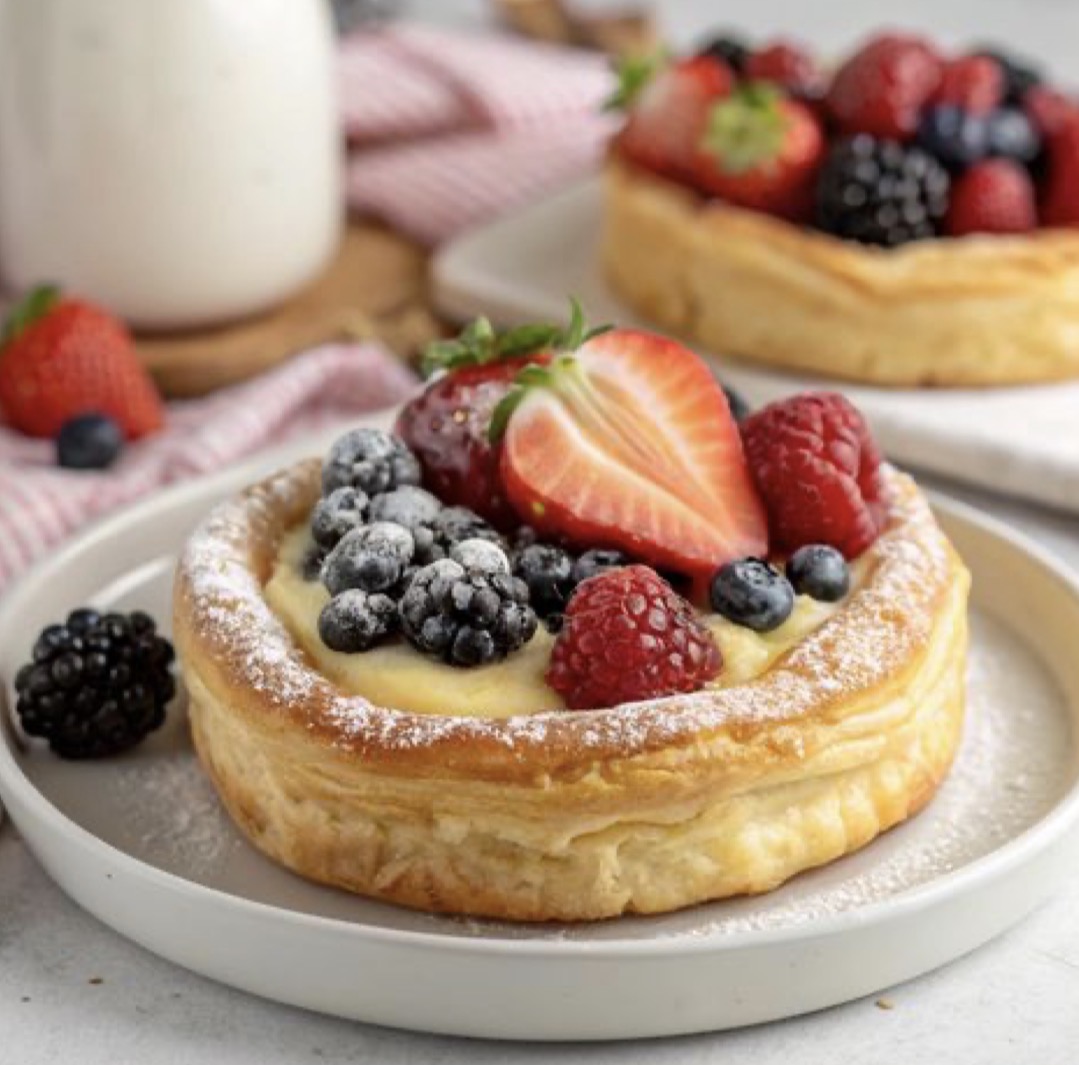
Puff Pastry Fruit Tart with Vanilla Custard
Also called Fruit Custard Danish or Individual Berry Tartlets, these tarts are the definition of simple elegance. You get a golden, buttery puff pastry shell that bakes up tall and shattery, a cool and creamy vanilla custard filling, and a crown of fresh berries with a dusting of powdered sugar. They look like they came from a French bakery, but they use only a handful of ingredients and take under an hour of active work.
This is the dessert to make when you want maximum impact for minimum effort. Serve them for brunch, Mother’s Day, baby showers, or as a light finish to dinner. Because they are individual portions, they plate beautifully and guests can grab one without slicing. The recipe scales easily from 4 to 24 tarts, and you can prep the components ahead so assembly takes minutes.
Why You Will Love This Recipe
The texture makes this tart special. Puff pastry bakes into hundreds of crisp, airy layers that shatter when you bite in. That crunch against cold, silky pastry cream is addictive. The fresh berries add acidity and color, and they keep the dessert from feeling heavy. Unlike a shortcrust fruit tart, you do not need to blind bake or worry about a soggy bottom. The pastry shell forms its own cup as it bakes, and the rim stays crisp even after filling.
Using store bought all-butter puff pastry keeps this approachable. The custard is a classic pastry cream, which is more stable than whipped cream and slices cleanly. It is also less sweet than frosting, so the fruit stays the star. Once you learn the technique, you can swap the fruit with whatever is in season.
Ingredients
Makes 6 individual 4-inch tarts
For the Puff Pastry Shells
Puff Pastry: 1 sheet, about 14 ounces, thawed. All-butter puff pastry gives the best flavor. Dufour, Trader Joe’s, and Wewalka are good options. Pepperidge Farm works if that is what you have. Thaw the pastry in the refrigerator overnight. Do not thaw at room temperature or the butter layers will melt and you will lose flakiness.
Egg Wash: 1 large egg beaten with 1 teaspoon water. This helps the pastry brown and gives it shine.
Powdered Sugar: For dusting after baking. Sift it so it falls evenly.
For the Vanilla Pastry Cream
Whole Milk: 1½ cups. Whole milk makes the custard rich and creamy. 2 percent works but will be thinner. Avoid skim milk.
Granulated Sugar: ⅓ cup. This sweetens the cream without making it cloying. You can increase to ½ cup if you like it sweeter.
Cornstarch: 3 tablespoons. Cornstarch thickens the custard and keeps it stable so it does not weep. It gives a cleaner flavor than flour.
Egg Yolks: 3 large. Yolks add richness, color, and help the custard set. Save the whites for meringue or add them to scrambled eggs.
Salt: Pinch, about ⅛ teaspoon. Salt balances the sugar and makes the vanilla flavor pop.
Pure Vanilla Extract: 1 teaspoon. Use real extract, not imitation. For a more intense flavor, use 1 vanilla bean. Split it, scrape the seeds into the milk, and add the pod while heating. Remove the pod before tempering.
Unsalted Butter: 1 tablespoon. Stirred in at the end, butter adds gloss and a rounded mouthfeel.
For the Fruit Topping
Fresh Strawberries: About 6 large, hulled and halved or sliced. Choose ripe, fragrant berries.
Fresh Raspberries: ½ cup. Handle gently because they crush easily.
Fresh Blackberries: ½ cup. Look for plump, shiny berries.
Fresh Blueberries: ½ cup. Smaller blueberries look better on individual tarts.
Optional Glaze: 2 tablespoons apricot jam plus 1 teaspoon water, warmed. A light brush of glaze gives the fruit shine and helps keep it from drying out.
You can use any mix of berries you like. In summer, try sliced peaches or nectarines. In winter, use segmented oranges or pomegranate seeds. Avoid frozen fruit for the topping. It releases too much liquid and will make the pastry soggy.
Equipment You Need
Muffin tin or 4-inch tart rings for shaping the shells
Rolling pin
Parchment paper
4-inch round cutter or a knife and small bowl to trace
Medium saucepan
Whisk
Fine mesh strainer
Mixing bowls
Rubber spatula
Small offset spatula
Piping bag or zip top bag, optional
Step by Step Instructions
Prepare and Bake the Puff Pastry Shells
Thaw your puff pastry in the fridge overnight. Cold pastry is easier to work with and rises better.
Preheat the oven to 400°F. Line a sheet pan with parchment paper. If you want deep, defined tart shells, use a standard 12-cup muffin tin. If you prefer a freeform rustic look, you can bake them flat on the sheet pan.
Lightly flour your work surface. Unfold the puff pastry and roll it gently to smooth the seams. You want it about 1/8 inch thick. Do not roll it too thin or it will not have enough layers to puff properly.
Use a 4-inch round cutter to cut 6 circles. If you do not have a cutter, place a small bowl on the dough and trace around it with a knife. Gather the scraps, press them together, and re-roll once if you need to cut more circles. Too much re-rolling will toughen the pastry, so try to get your cuts on the first pass.
For Muffin Tin Shells: Press each dough circle into a muffin cup. Prick the bottom of each several times with a fork. This keeps the base flat while the edges rise up to form a rim. Chill the tin for 15 minutes. Cold dough going into a hot oven gives the best rise.
For Freeform Shells: Place the circles on the parchment lined sheet pan. Use a 3-inch cutter or glass to score a light circle inside each round, about ½ inch from the edge. Do not cut all the way through. Prick only the inner circle with a fork. When it bakes, the outer ring will puff up and the center will stay flatter, creating a natural well for the custard. Chill 15 minutes.
Brush the edges of the pastry with egg wash. Avoid getting wash on the cut sides or it can seal the layers and prevent rise.
Bake for 15 to 18 minutes, until the pastry is deeply golden brown and feels firm. The color is important. Pale pastry equals soggy pastry. If you used the muffin tin, the centers may puff up. While the shells are still hot, use the back of a spoon to gently press the centers down to make a well.
Cool the shells completely on a wire rack. They will crisp as they cool. You can bake these up to 1 day ahead. Store in an airtight container at room temperature. If they soften, re-crisp in a 350°F oven for 5 minutes.
Make the Vanilla Pastry Cream
Pastry cream sounds technical, but it is just a stovetop custard. The key is to cook it fully so the cornstarch activates and the egg flavor cooks out.
Pour 1½ cups milk into a medium saucepan. Add half the sugar, about 2.5 tablespoons. If using a vanilla bean, add the seeds and pod now. Set over medium heat and warm until steaming and small bubbles form around the edge. Do not boil.
In a separate bowl, whisk the 3 egg yolks, remaining sugar, cornstarch, and salt. Whisk for a full minute until the mixture is pale and smooth. It will be thick.
Now temper the yolks. While whisking constantly, slowly pour about ½ cup of the hot milk into the yolk mixture. This warms the yolks gradually so they do not scramble. Pour the warmed yolk mixture back into the saucepan with the rest of the milk, whisking the whole time.
Return the pan to medium heat. Whisk constantly and make sure to get into the corners of the pan. The mixture will thicken suddenly. Once it starts to bubble, let it boil for 1 full minute, whisking. Boiling is necessary to cook out the raw cornstarch taste and to ensure the cream will set. It should be thick like pudding.
Remove from heat. Strain the cream through a fine mesh strainer into a clean bowl. This catches any bits of cooked egg and gives you a silky texture. Stir in the vanilla extract and the tablespoon of butter until smooth.
Press a piece of plastic wrap directly on the surface of the custard. This prevents a skin from forming. Refrigerate until completely cold, at least 2 hours. Pastry cream must be cold before you fill the tarts or it will melt the pastry. You can make it up to 3 days ahead.
Assemble the Tarts
Take the cold pastry cream and whisk it briefly to loosen it. It will have set firm in the fridge. If you want perfect domes, transfer it to a piping bag fitted with a large round tip. You can also just spoon it in.
Fill each puff pastry shell with about 3 tablespoons of custard. Spread it or pipe it so it comes just below the rim. Do not overfill or it will spill when you add fruit.
Arrange the berries on top of the custard. Start with larger pieces like halved strawberries, then fill in gaps with raspberries, blackberries, and blueberries. Press them in lightly so they adhere. You can create a pattern or just pile them on. The goal is to cover most of the custard while keeping it colorful.
If you want a professional finish, warm 2 tablespoons of apricot jam with 1 teaspoon of water for 10 seconds in the microwave. Brush it lightly over the fruit. This is called an apricot nappage and it gives the berries shine and keeps them fresh.
Dust the edges of the pastry with powdered sugar just before serving. Do it at the last minute because the sugar will melt into the pastry if it sits too long.
Serve
These tarts are best the day they are assembled. The pastry is at its crispest and the fruit is freshest. Serve chilled or at cool room temperature. If your kitchen is warm, keep them in the fridge until 15 minutes before serving.
To cut them, use a sharp serrated knife and a gentle sawing motion. The pastry will shatter, so do not press down hard.
Expert Tips for Perfect Tarts
Keep the Pastry Cold: Warm puff pastry will not rise. If it gets soft while you work, put it back in the fridge for 10 minutes. Cold butter in the dough creates steam, and steam creates layers.
Bake Dark: You want a rich golden brown color. Underbaked puff pastry is doughy and will collapse when filled. If the edges are brown but the center looks pale, tent the edges with foil and bake 3 to 5 minutes more.
Cook the Custard Fully: If your pastry cream is runny, you did not cook it long enough after it came to a boil. That one minute of boiling is critical for the cornstarch to set.
Strain the Custard: Do not skip the strainer. Even if you temper perfectly, a few bits of egg can cook. Straining guarantees a smooth, professional texture.
Assemble Before Serving: Puff pastry absorbs moisture. Once you add custard, the clock starts. For the best texture, fill the shells within 2 hours of serving. You can hold them longer in the fridge, but the pastry will soften slightly.
Dry Your Fruit: Wash berries and let them dry completely on paper towels. Wet berries will weep and water down the custard.
Recipe Variations
Chocolate Pastry Cream: Whisk 3 ounces of finely chopped dark chocolate into the hot pastry cream after straining. Let it sit 1 minute, then stir until smooth. Top with raspberries for a classic combo.
Lemon Cream Tarts: Add 1 tablespoon of lemon zest to the milk when heating. Replace 2 tablespoons of the milk with fresh lemon juice, added after the cream is cooked. Top with blueberries and candied lemon peel.
Almond Frangipane: Instead of custard, fill the shells with almond cream and bake for a second time. This is a different style called Bostock or almond tart.
Savory Version: Skip the sugar in the pastry cream and add grated parmesan and black pepper. Fill the shells and top with cherry tomatoes and basil for an appetizer.
Large Tart: Use a 9-inch tart pan. Line it with a full sheet of puff pastry, prick the base, and bake with pie weights for 15 minutes, then uncovered for 10 more. Cool, fill with all the custard, and arrange fruit on top. Slice into wedges.
Make Ahead and Storage
This recipe has three components and each can be prepped ahead.
Pastry Shells: Baked and cooled shells keep 1 day at room temperature in an airtight container. Re-crisp 5 minutes in a 350°F oven if needed. Unbaked cut shells can be frozen on a sheet pan, then stored in a bag up to 1 month. Bake from frozen and add 2 to 3 minutes to the bake time.
Pastry Cream: Keeps 3 days in the fridge with plastic wrap pressed on the surface. Whisk to smooth before using. Do not freeze. It will break and turn watery when thawed.
Assembled Tarts: Best within 4 hours. You can hold them up to 24 hours in the fridge, but the pastry will lose some crispness. Do not cover them tightly or the fondant and fruit will sweat. Store loosely covered with plastic wrap or in a bakery box.
Do not freeze assembled tarts. The custard and fruit do not thaw well and the pastry turns tough.
Troubleshooting
Shells Did Not Puff: The dough was too warm, or the oven was not hot enough. Make sure to chill the shaped dough and verify your oven temperature with a thermometer.
Shells Are Soggy: They were underbaked, or you filled them too far in advance. Bake until deeply golden and fill close to serving time. You can brush the inside of the shell with melted white chocolate and let it set. This creates a moisture barrier.
Custard Is Lumpy: You did not whisk constantly or the heat was too high. Always strain it. If it is already lumpy, you can try to save it by blending with an immersion blender while it is still hot.
Custard Is Too Thin: It did not boil long enough, or you measured the cornstarch incorrectly. Next time, boil a full minute and level your tablespoons. For this batch, chill it longer. It will thicken somewhat when cold.
Fruit Is Leaking: The berries were wet or overripe. Pat fruit very dry and choose firm berries. The apricot glaze also helps seal them.
Frequently Asked Questions
Can I use instant pudding instead of pastry cream?
You can in a pinch, but the texture and flavor are different. Instant pudding is often gummier and much sweeter. If you use it, make it with whole milk and use less milk than the box calls for so it sets firmer. Pastry cream tastes far better and is worth the 10 minutes.
Can I make these without a muffin tin?
Yes. The freeform method in the instructions works well. The edge will not be as deep, but the center will still sink enough to hold the custard. You can also bake the full sheet of pastry, then cut it into squares after baking and top each square with cream and fruit.
What if I only have vanilla pudding mix?
Cook and serve pudding is closer to pastry cream than instant. Make it according to package directions, then whisk in 1 tablespoon of butter at the end. Chill fully before using.
Can I use frozen berries?
Not for the topping. They release too much liquid as they thaw and will make the tart soggy and messy. You can cook frozen berries into a compote and swirl that into the pastry cream, but use fresh for the top.
How do I keep the powdered sugar from melting?
Use a non-melting or doughnut sugar, sold as snow sugar. Regular powdered sugar will dissolve if it sits on the fruit or cream for more than 30 minutes. Dust right before serving for best results.
Is there a dairy free version?
Yes. Use a good quality dairy free puff pastry. For the custard, replace whole milk with full fat canned coconut milk or a rich oat milk. Use a vegan butter or coconut oil. The flavor will be slightly different but still good.
Serving and Pairing Suggestions
These tarts are lovely on their own, but you can plate them with a few extras. A small scoop of vanilla ice cream or a dollop of lightly whipped cream on the side is nice. A drizzle of raspberry coulis on the plate adds color and acidity.
For drinks, pair with coffee, espresso, or black tea. The bitterness balances the sweet cream. For brunch, serve with mimosas or a glass of Prosecco. The bubbles and acidity cut through the buttery pastry.
If you are making these for a party, set up a tart bar. Put out the baked shells, a bowl of custard, and several bowls of fruit. Let guests build their own. It is interactive and you do not have to worry about the pastry softening because they are assembled to order.
Final Thoughts
Puff Pastry Fruit Tarts with Vanilla Custard are one of those recipes that look complicated but break down into simple steps. Bake the shells, cook the cream, add fruit. Each part is straightforward, and none of them require special equipment or techniques beyond a whisk and a little patience.
The payoff is huge. You get a dessert that looks professional, tastes like summer, and can be adapted to any season or occasion. Master this base recipe and you will have a go-to for showers, holidays, and dinner parties. The combination of crisp, creamy, and fresh is timeless for a reason.